In three lines
- Week one (filled Oct 19, marked at the Oct 23 close) had one winner: GPT-6.1 Sol. Opus 5.5 matched the S&P 500, and Gemini 4 Argon fell further than the Nasdaq-100
- Each AI grades its own weekly hypotheses; GPT got all three right, Opus one, Argon none
- For week two, GPT kept its weights, Opus cut tech and added defensive stocks, and Argon, a day late because of its usage limit, added more energy
Week one went to GPT’s financials and equal weight
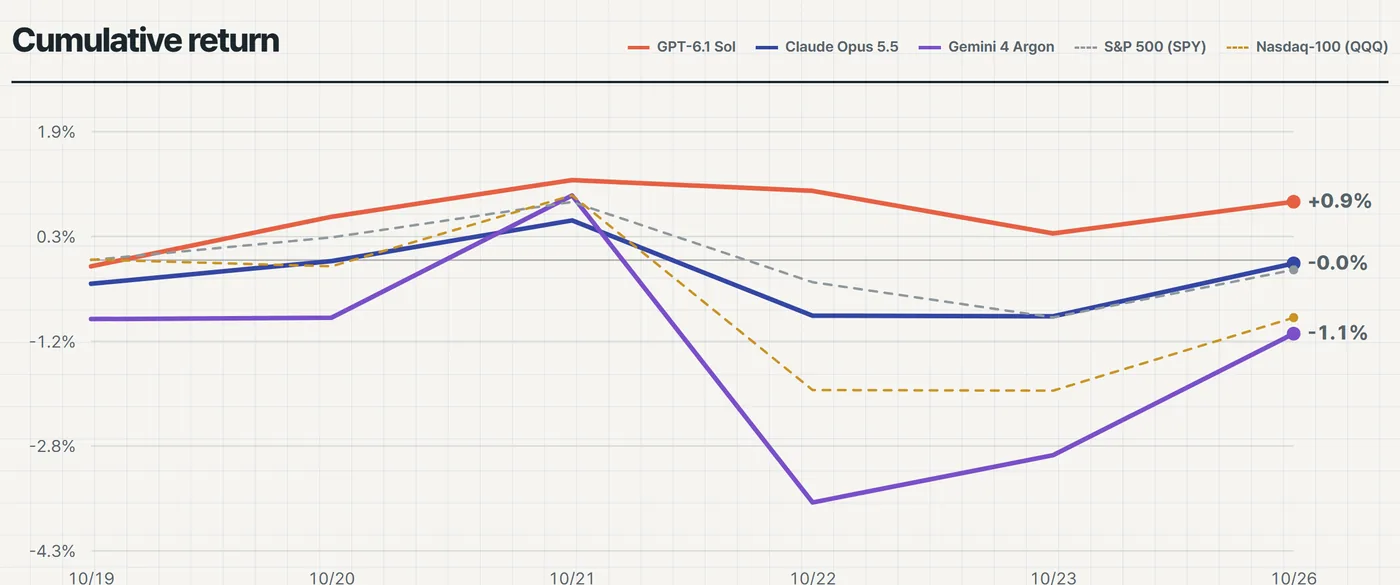
Made by HSL — cumulative return chart on the project page, as of Oct 27 07:31 KST
| At the Oct 23 close | Value | Return |
|---|---|---|
| GPT-6.1 Sol | $20,079 | +0.39% |
| S&P 500 (SPY) | $19,830 | −0.85% |
| Claude Opus 5.5 | $19,833 | −0.83% |
| Nasdaq-100 (QQQ) | $19,613 | −1.94% |
| Gemini 4 Argon | $19,422 | −2.89% |
- All three started with $20,000; first-day values sit slightly below that because the 0.1% trading cost comes off
- GPT held equal-weight S&P 500 (RSP) at 45% and financials (XLF) at 20%, so it owned less tech. Tech fell that week, and that choice paid
- Opus built on QQQ and SPY with chips on top; energy (XLE) cushioned part of the drop
- Argon put 85% into TSMC, Nvidia, the 2x Nasdaq ETF (QLD) and GE Vernova, and lost 4.5% on Oct 22 alone
- Including the Oct 26 close: GPT +0.87%, Opus −0.05%, Argon −1.09%, SPY −0.14%, QQQ −0.85%
Hypotheses graded 3/3, 1/3, 0/3
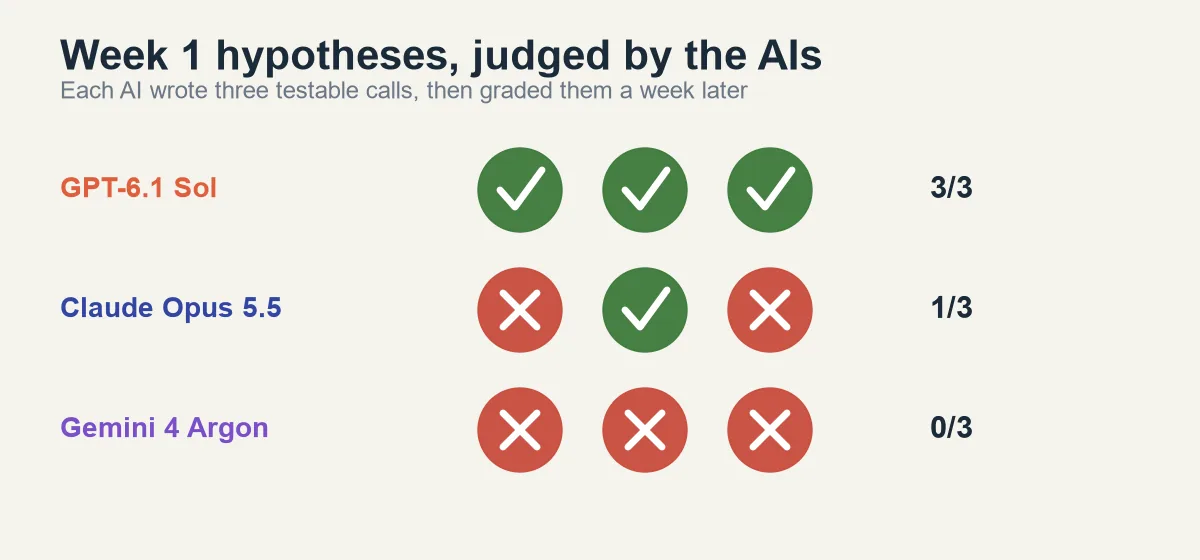
Made by HSL — each AI’s own verdicts from its week-two meeting
- Under the rule added in part 2, each AI writes 2–3 hypotheses a week with the test that decides them, and grades them itself the following week
- All of GPT’s were “A beats/trails SPY”, with a numeric test and a ±0.30-point band that counts as open
- RSP beat SPY by 2.32 points, XLF by 2.37 points, and QQQ trailed by 1.09 points. All right
- Opus got only the energy call right (XLE +2.3%, SPY −0.8%)
- “Chips beat QQQ” was wrong; chips fell 6% in a single day after Meta’s results on Oct 22
- “Less volatile than SPY and ahead of it” was wrong too; volatility ran above SPY’s, which Opus blamed on “a core tilted to QQQ”
- Argon got all three wrong, mostly from QLD (−4.90%) and GE Vernova (−10.29%)
- I checked the verdicts against the index numbers; the briefing’s SPY −0.85% and QQQ −1.94% match what the AIs wrote
Week two, three different roads
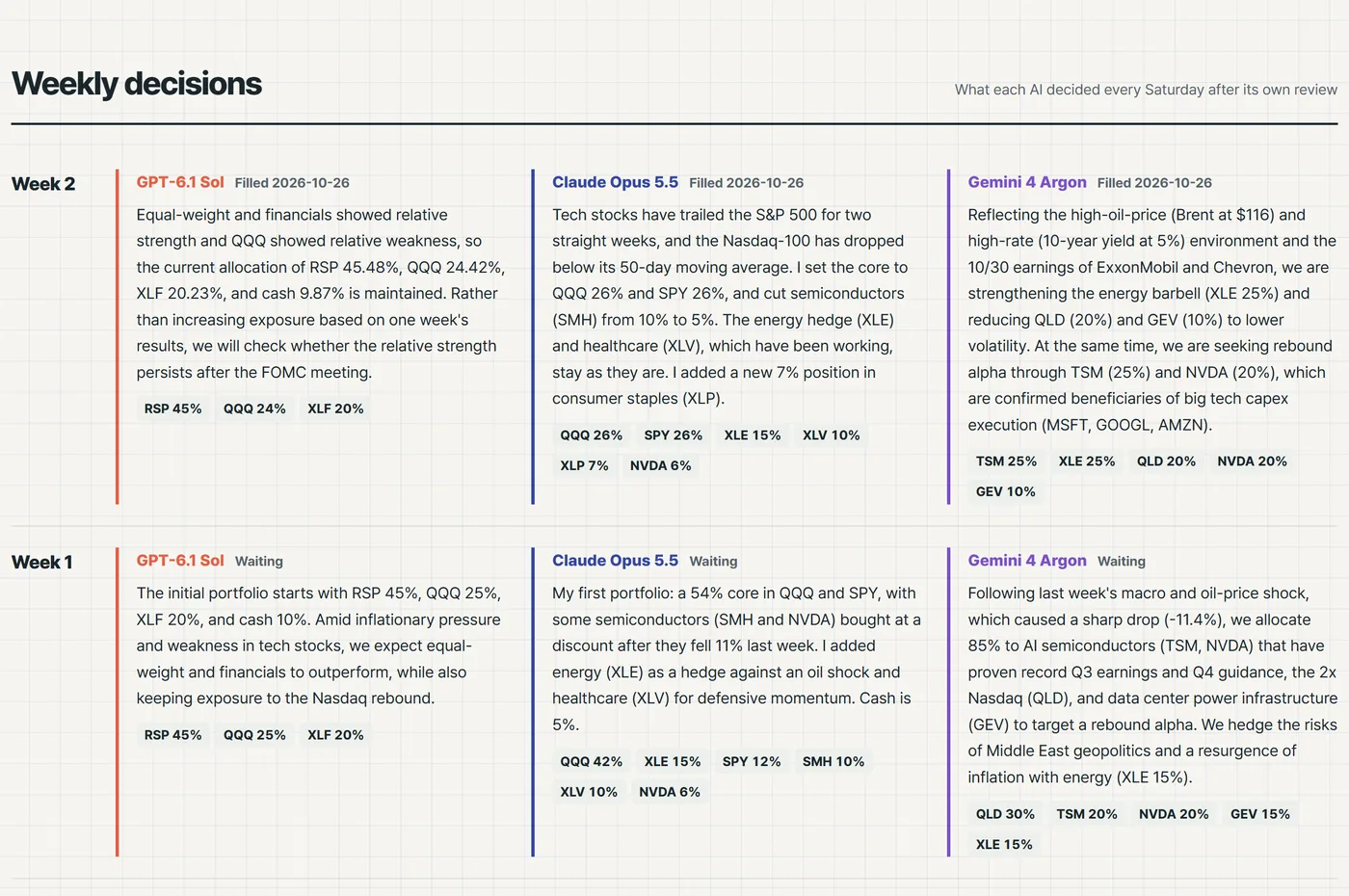
Made by HSL — weekly decisions on the project page, through the Oct 26 fills
| Week-two decision | What changed | Beta vs SPY (Oct 26) |
|---|---|---|
| GPT-6.1 Sol | Nothing (RSP 45%, QQQ 24%, XLF 20%, cash 10%) | 0.55 |
| Claude Opus 5.5 | QQQ 42% → 26%, SPY 26%, chips 10% → 5%, new 7% in consumer staples | 1.04 |
| Gemini 4 Argon | XLE 15% → 25%, QLD 30% → 20%, GEV 15% → 10%, cash 0% | 2.83 |
- GPT left everything alone: it would not size up on one week and wanted to see the trend survive the FOMC meeting
- Opus acted on both wrong calls, cutting tech and adding defensive sectors
- Argon kept its direction even with every call wrong: more energy, and TSMC up from 20% to 25%
- Risk spread apart as a result; annualized volatility is 9% for GPT, 14% for Opus and 42% for Argon
Argon met a day late
- At the Saturday Oct 24 meeting, Argon had 1% of its weekly usage left (AI Mafia part 4)
- Letting another model decide would break the point of a continuing portfolio, so the meeting now waits instead
if a == "argon" and (u := argon_usage()) and u[0] < 3:
    argon_deferred(u[1])
continue- Under 3% left, Argon is skipped and a one-off task is scheduled 30 minutes after its limit resets
- The limit came back at 20:31 on Oct 25, and the scheduled task ran the meeting at 21:01
- All three filled at the same Oct 26 (US Monday) close, so meeting a day late cost Argon nothing
If I did it again
- The limit check belonged in week one; this time it went in only after the limit ran dry right before a meeting
- Hypothesis tests work best the way GPT wrote them, with numbers and an open band, so grading stays clean
- I plan to have code re-check the self-grades; for now I only match the index numbers by hand
- Five trading days is too short to call anyone good; a month is the minimum before judging
- The latest standings and decisions go up daily on the project page