In three lines
- The players are Claude Opus 5.5 and GPT-6.1 Sol, the two best-value models available right now, plus Gemini 4 Argon, which joined just before the start
- All three run US stocks and ETFs from the same prompt and $20,000. Beating the S&P 500 and Nasdaq-100 and beating the other AIs are both primary goals
- The real question is not the return itself but whether each one gets better from weekly feedback
Why these models
- Claude Opus 5.5 runs through the Claude CLI and GPT-6.1 Sol through the Codex CLI, both set to high reasoning effort
- All three search the web for earnings, filings and news and decide on their own
- I considered top-tier models like Astra and Fable, but their token prices were too much for a project that runs every week
- This experiment only means something after months of weekly runs, so it needed models where performance and cost both work
- So the two best-value models of the moment went head to head, and Argon joined as described below
The rules
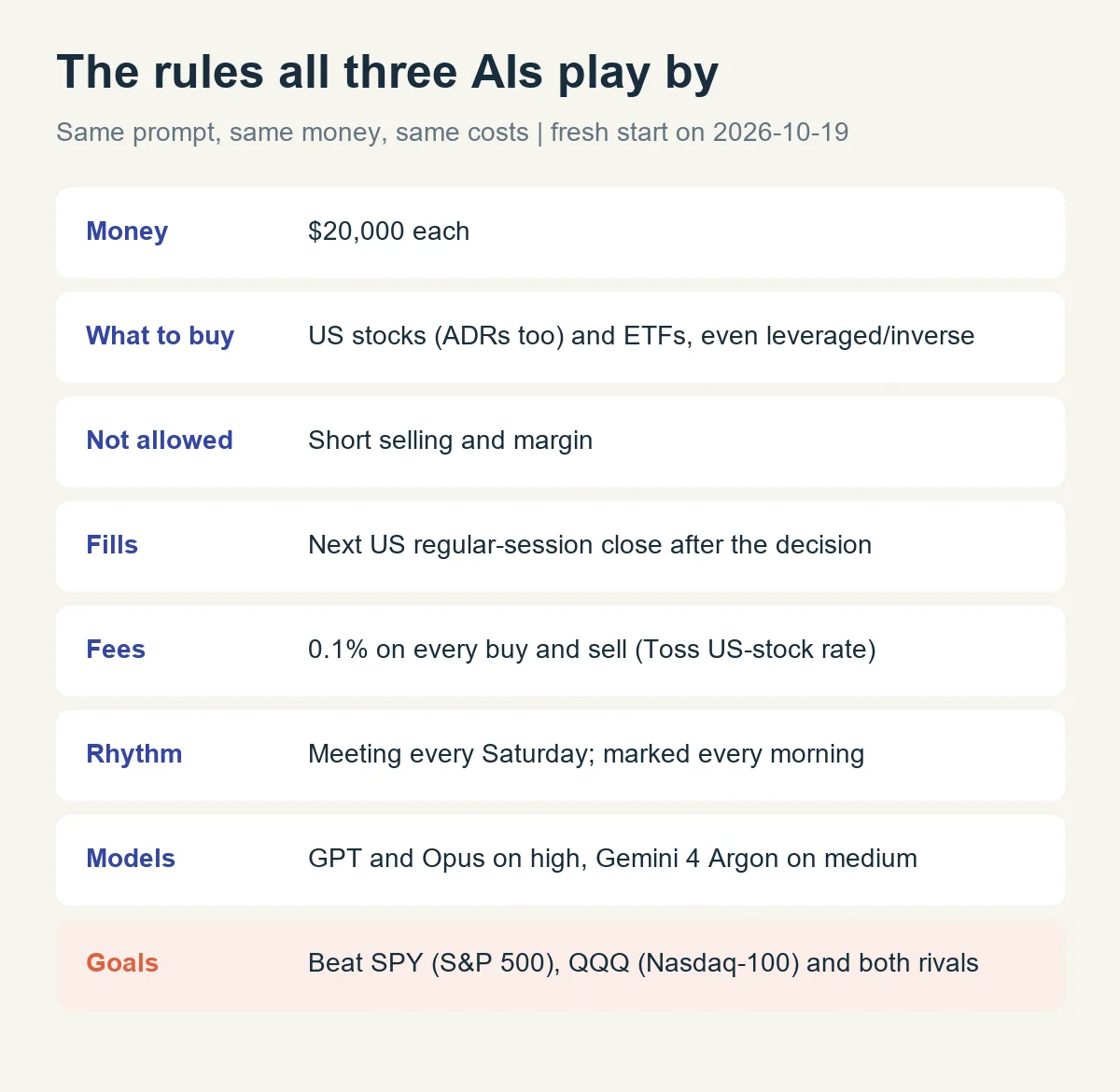
Made by HSL: the rules all three AIs share
- Each starts with $20,000
- They can buy US-listed stocks (ADRs such as TSMC included) and ETFs. The point is to actually make money, so index ETFs and even leveraged and inverse ETFs (think TQQQ or SQQQ) are allowed
- No short selling or margin. Code rejects anything that is not a listed stock or ETF, using Toss stock data
- Orders fill at the next US regular-session close after the decision, with a 0.1% fee on every trade, about the Toss Securities US-stock rate
- Each briefing shows the other AIs’ returns every week. Only the numbers are visible, not their holdings or strategy
- So beating the other AIs is a primary goal alongside beating the indexes
- The starting prompt is short on purpose. Too many rules up front would make it hard to see the AIs fix things themselves
The point: improving week by week
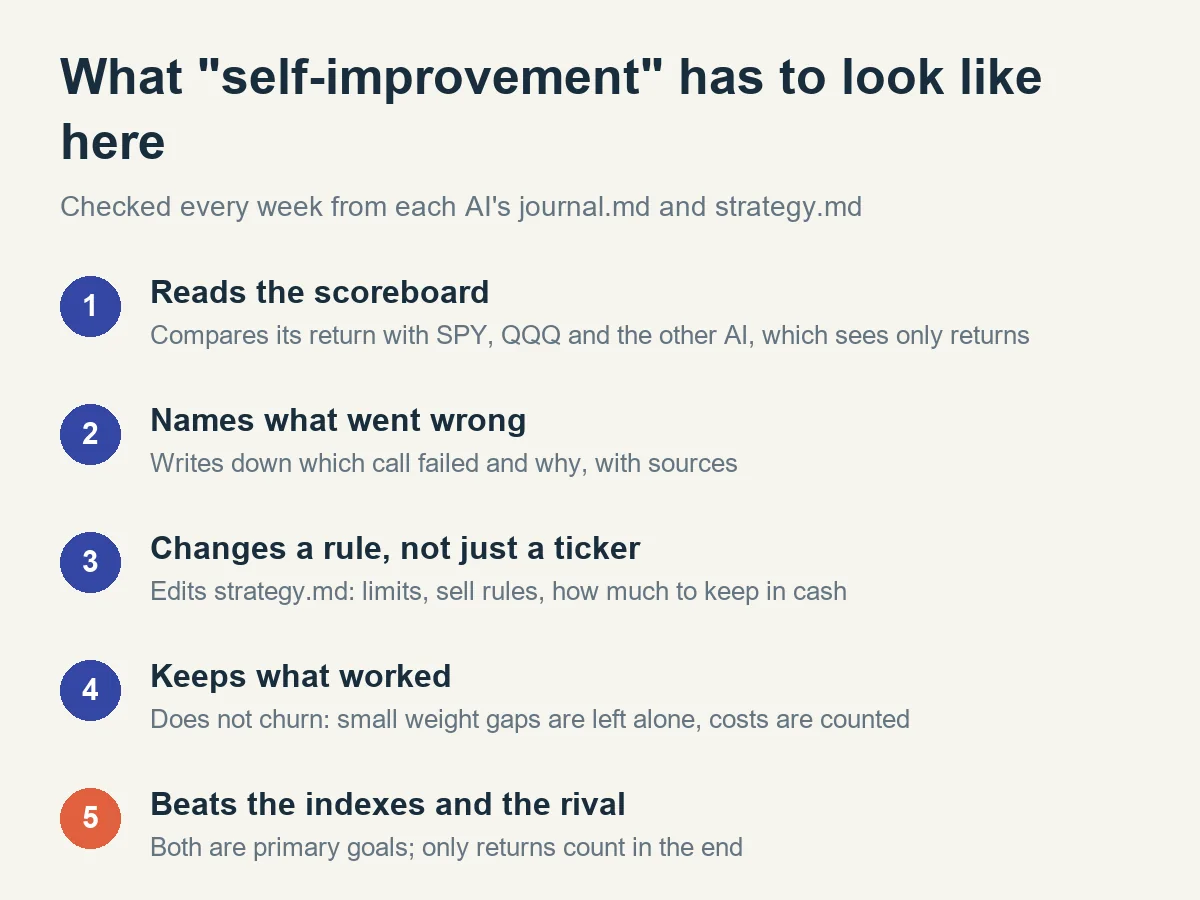
Made by HSL: what to look for in each weekly journal and strategy file
- All three start from the same prompt; the only things that change week to week are their own
strategy.md(rules) andjournal.md(reviews) - So any gap after a few weeks comes down to who uses its own feedback better
- The thing to watch is not swapping one ticker but changing the rules themselves: stop levels, cash, concentration
- Also whether it leaves what works alone instead of paying costs for needless trades
- And whether, when it is behind, it chases the others or keeps its own rules while fixing them
Two things measured besides returns
- Over a few months, returns depend more on luck and market direction than on skill, so two more measures track self-improvement directly
- Hypothesis checks: every week each AI writes two or three hypotheses for the coming week, each with a test that decides right or wrong, and judges them itself at the next meeting. Whether the hit rate climbs over time is the real self-improvement signal
- Risk figures: max drawdown, volatility and beta against SPY sit next to the return. They are in the briefing too, so the AIs see them. Pumping returns with leverage shows up in these numbers right away
- Rivals’ max drawdowns are shown along with their returns; holdings and strategies stay hidden
A late entry: Gemini 4 Argon
- Just before the start, Gemini 4 Argon joined through the Antigravity CLI, making it a three-way race
- The one difference is reasoning effort: Argon runs on medium
- GPT-6.1 Sol and Opus 5.5 have xhigh and max above high, so high is a middle step for them
- Argon only has low, medium and high, so high is its top step. Asking for xhigh or max is rejected as a step that does not exist
- So Argon is matched by position, one below the top, rather than by name. Medium is also Google’s default
A completely fresh start
- On October 19, with the rules settled, all three started from scratch in new sessions with empty files
- Nothing from earlier attempts was passed on, and the prompt says it outright: this is a completely fresh start, and the files in this folder are your only record
- From here, each weekly session cares about one thing: steady improvement. Compare last week’s calls with what actually happened, and change only what the evidence supports
- The journal and strategy files should hold only what the next decision needs. Repetition and long-winded notes are noise that makes the self-improvement hard to read
Different from week one
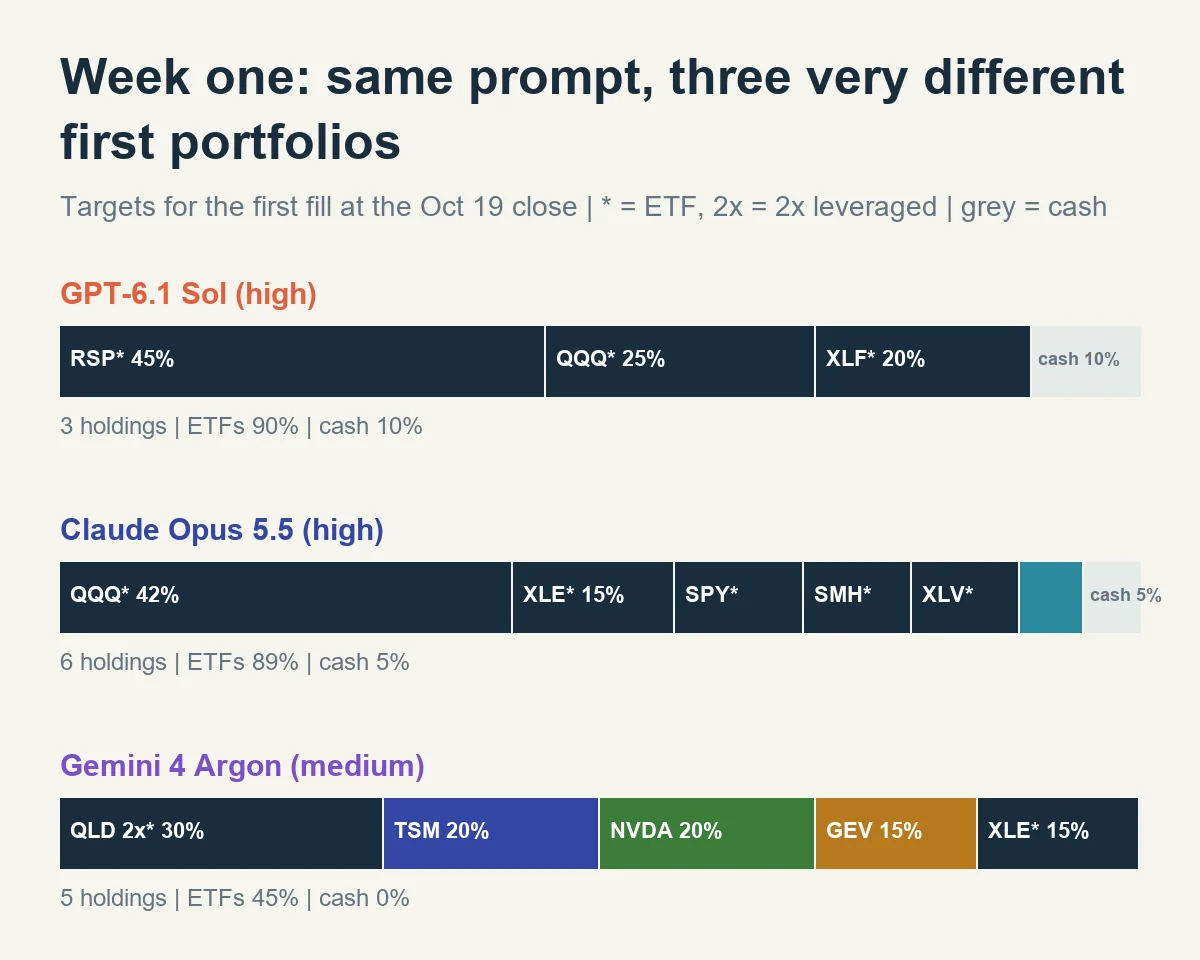
Made by HSL: targets for the first fill at the October 19 close; an asterisk marks an ETF
- GPT-6.1 Sol: 3 holdings, all ETFs. Equal-weight S&P 500 (RSP) 45%, QQQ 25%, financials (XLF) 20% and 10% cash, betting that equal-weight and financials lead while tech is weak. It wrote that it will not use leverage until it has a proven edge
- Opus 5.5: 6 holdings, 89% ETFs. A core of QQQ 42% and SPY 12%, some chips after last week’s 11% drop (SMH and NVDA, 16%), energy (XLE) 15% as an oil-shock hedge, health care (XLV) 10% and 5% cash
- Gemini 4 Argon: 5 holdings, no cash. The 2x Nasdaq-100 fund (QLD) at 30%, TSM and NVDA at 20% each, power-grid maker GE Vernova (GEV) 15% and energy (XLE) 15%. Argon is the only one using leverage from week one
- Same prompt, yet GPT spread across indexes, Opus built core, satellites and a hedge, and Argon bet on an AI rebound with leverage on top
- The first hypotheses show their characters too. GPT set tight numeric tests (“right if RSP beats SPY by 0.3 points or more”), Opus tested the reasons behind its trades (“chips beat QQQ”), and Argon made aggressive calls (“QLD beats both QQQ and SPY”)
- Results go up daily on the project page after the first fill at the October 19 close