One-Line Take
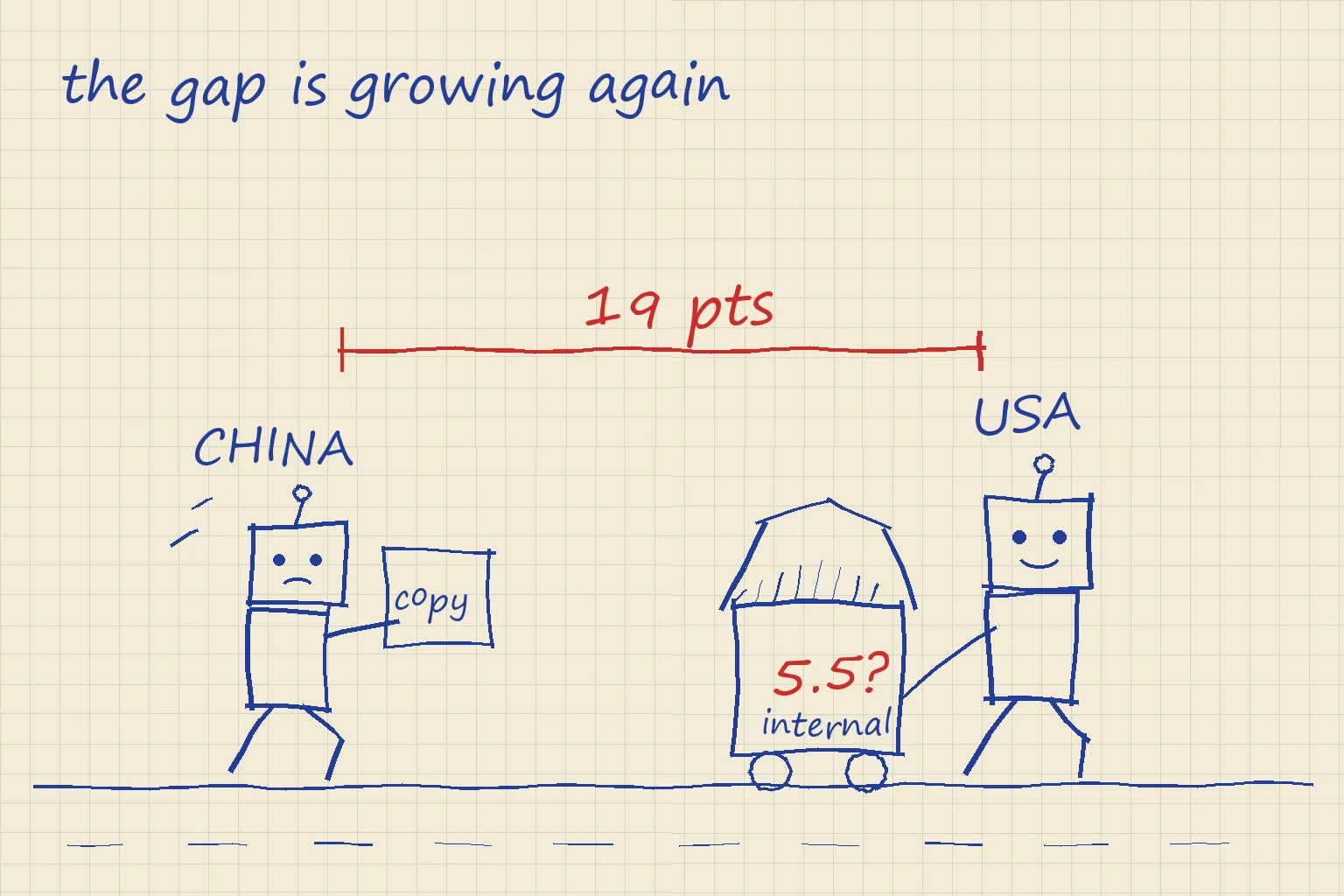
US big tech is ending the chase by stockpiling its top models and closing the doors, and I expect the gap to keep growing (author's view)
China Got Within Reach, Then Fell 19 Points Behind
- The US–China AI gap has widened a lot lately. On Artificial Analysis, China had nearly caught up, then got pushed back (author's view)
- On Artificial Analysis (AA) Intelligence Index v4.3, the leader was only 3 points ahead of Kimi K3.1 Pro (AA v5 announcement)
- Kimi K3.1 Pro is from China's Moonshot and is AA's top open-weights model, though its weights are not out yet (Dealroom)
- On October 27, the day the index moved to v5, the gap became 12 points: Opus 5.5 at 58, Kimi at 46
- On November 9, Fable 5.2 scored 65 and the gap reached 19 points on the same v5 test1 (AA leaderboard)
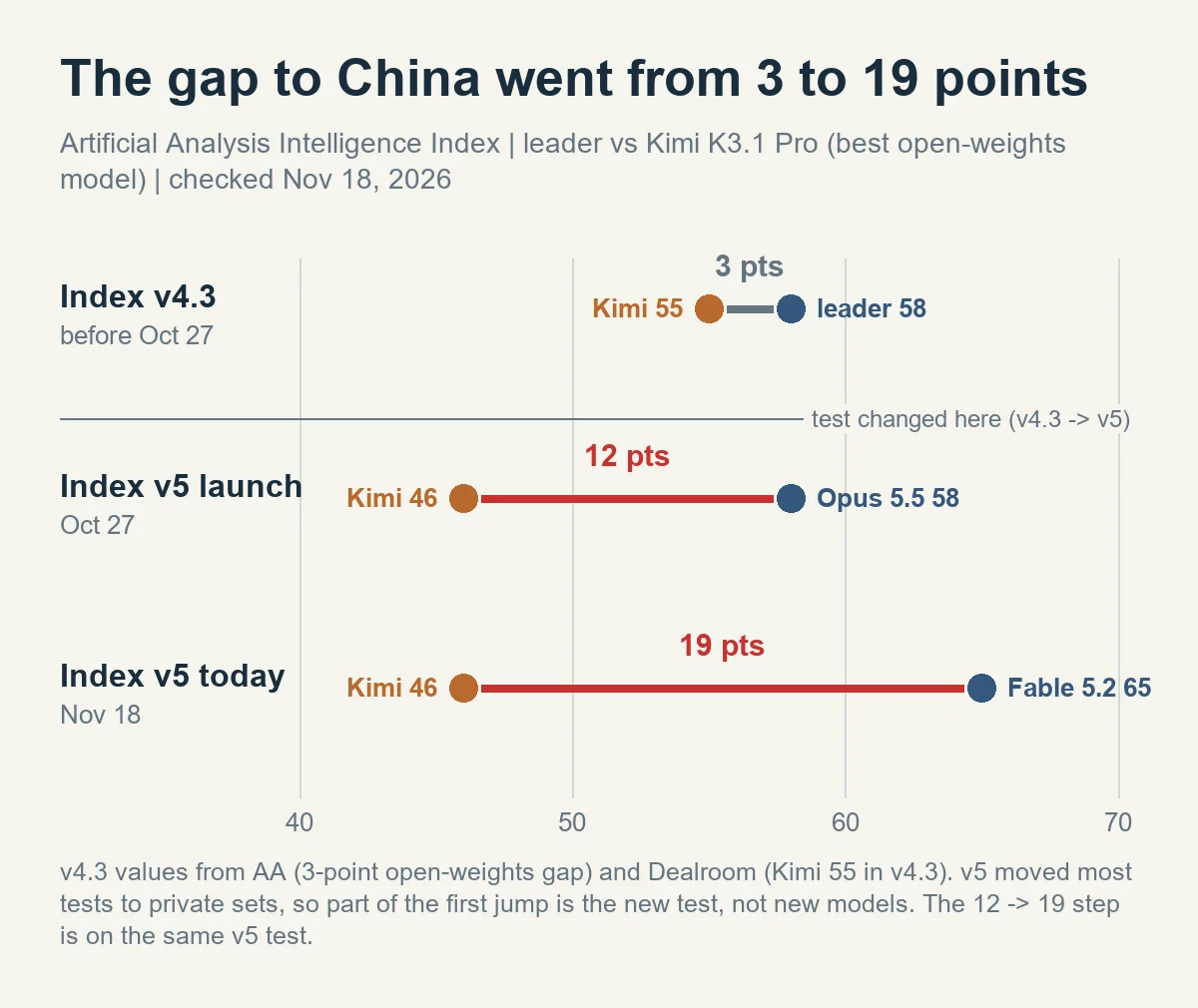
Made by HSL — AA v5 announcement, AA leaderboard, Dealroom, checked November 18, 2026
- The best Chinese model whose weights you can download is DeepSeek V4.1 Flash at 33
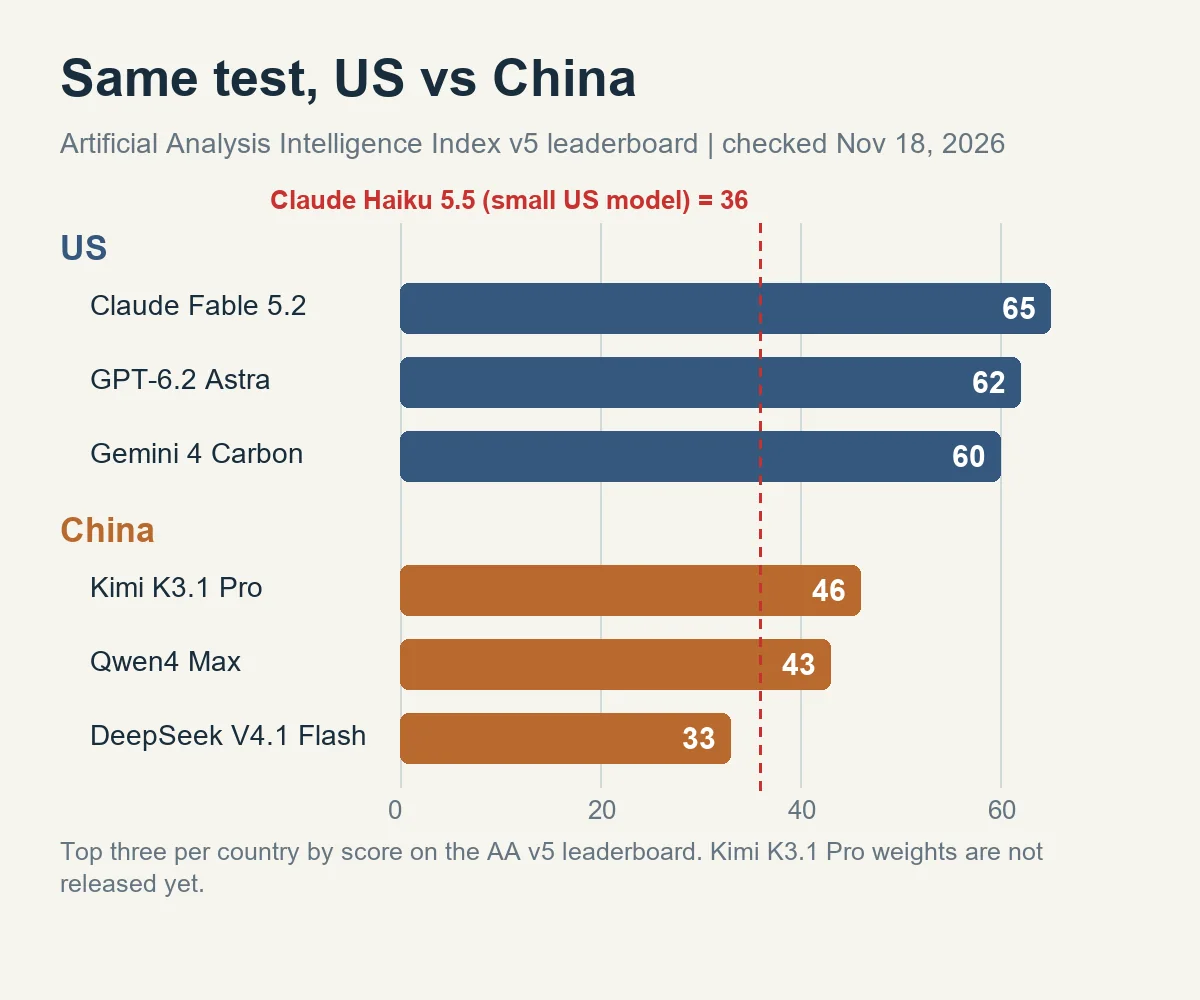
- That is below even Claude Haiku 5.5 (36), a small US model
China's Shortcut Was Claude's and GPT's Answers
- China improves its own models, but it has also trained on Claude's and GPT's questions and answers to get at least close (author's view)
- Teaching a weaker model with a stronger model's answers is called distillation
- On February 23, Anthropic said DeepSeek, Moonshot and MiniMax had distilled Claude at scale (Anthropic)
- About 24,000 fake accounts pulled more than 16 million exchanges
- By lab: MiniMax over 13 million, Moonshot over 3.4 million, DeepSeek over 150,0002
- They went after agentic reasoning, tool use and coding, where Claude leads most
- DeepSeek reportedly had Claude write out the step-by-step reasoning behind finished answers to build training data
- On February 12, OpenAI also told the House China committee that DeepSeek "free-rides" through distillation (TNW)
- On April 23, the White House science office (OSTP) formally called out China's "industrial-scale" distillation
The US Chose to Close the Doors
- Anthropic and OpenAI are fighting this chase by keeping models closed (author's view)
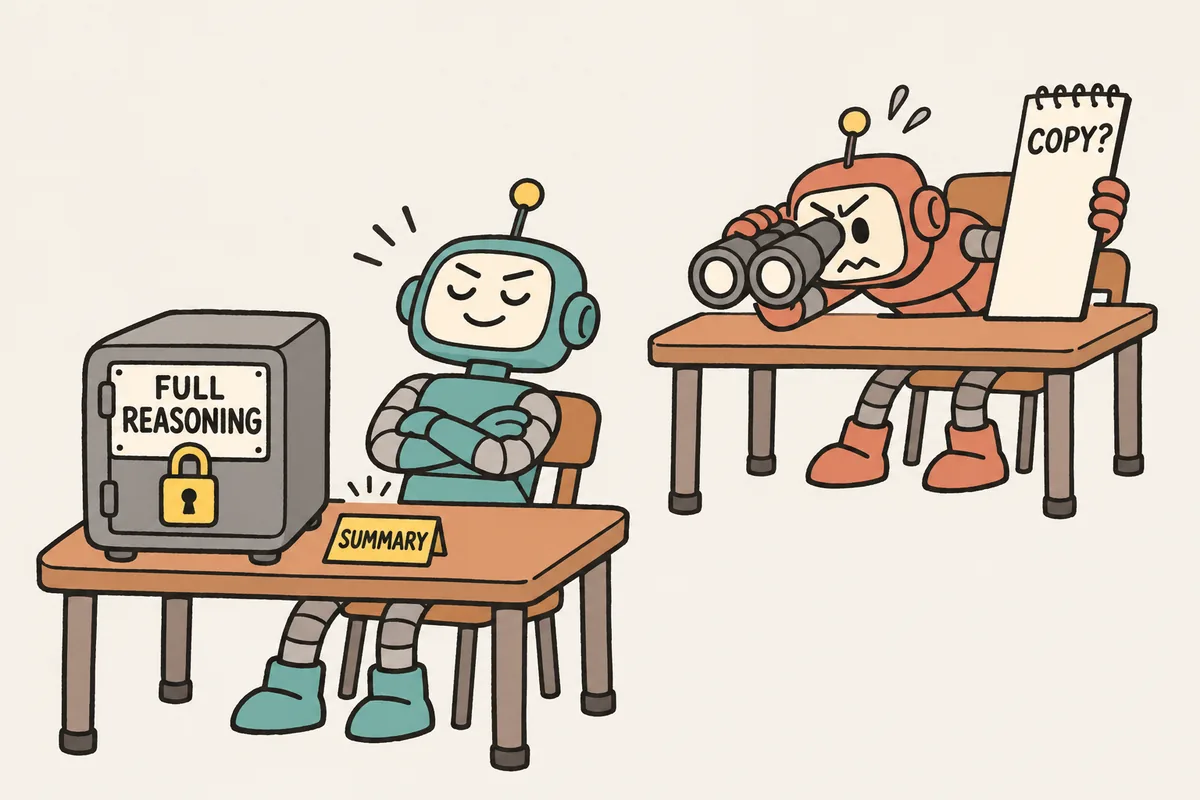
- Anthropic first started showing Claude's reasoning only in summarized form (Anthropic)
- In its test, a model distilled on full reasoning scored 80.4% on SWE-bench Verified, versus 71.8% on summaries
- API accounts created on or after August 31 can no longer edit Claude's earlier context, closing a path used to pull out reasoning
- Requests that try to extract reasoning are blocked by classifiers as robust as its bioweapon safeguards, with under 0.1% false positives
- On October 12, Anthropic said the data distillers could extract had fallen by about 90–99%
- Fable 5.2, out November 9, carries what Anthropic calls its strongest-ever distillation protections (Anthropic)
The answers stay in the safe
- The government moved the same way. On June 12, the Commerce Department ordered Anthropic to keep foreign nationals off Fable 5 and Mythos 5 (Spokesman-Review/Bloomberg)
- To comply, Anthropic pulled both models from every customer worldwide for a while
- The US had never before limited foreign access to an American lab's frontier models this broadly
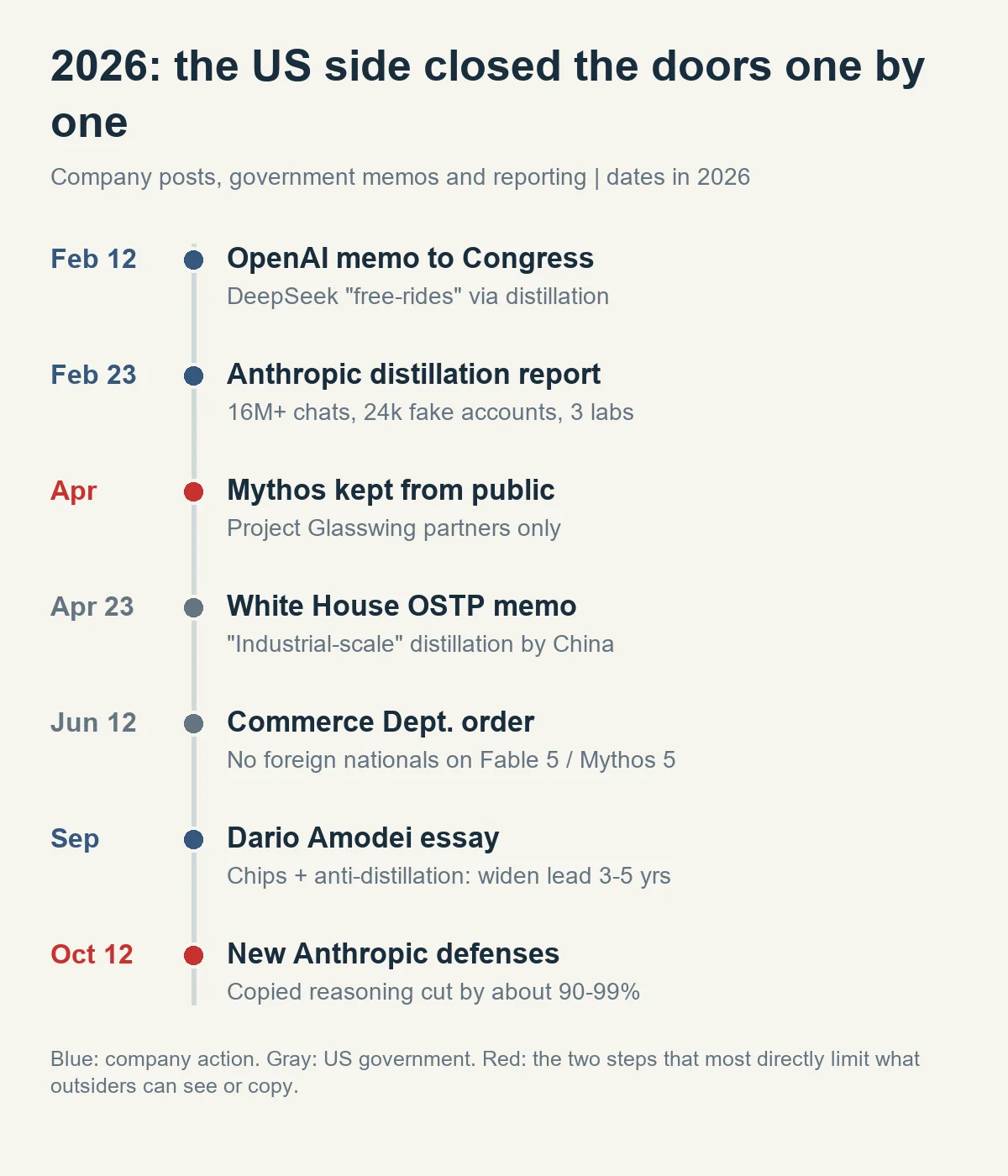
Made by HSL — company posts, government memos and reporting
- Anthropic's CEO wrote that chip controls and a distillation crackdown would widen America's lead significantly over the next 3–5 years3 (Dario Amodei)
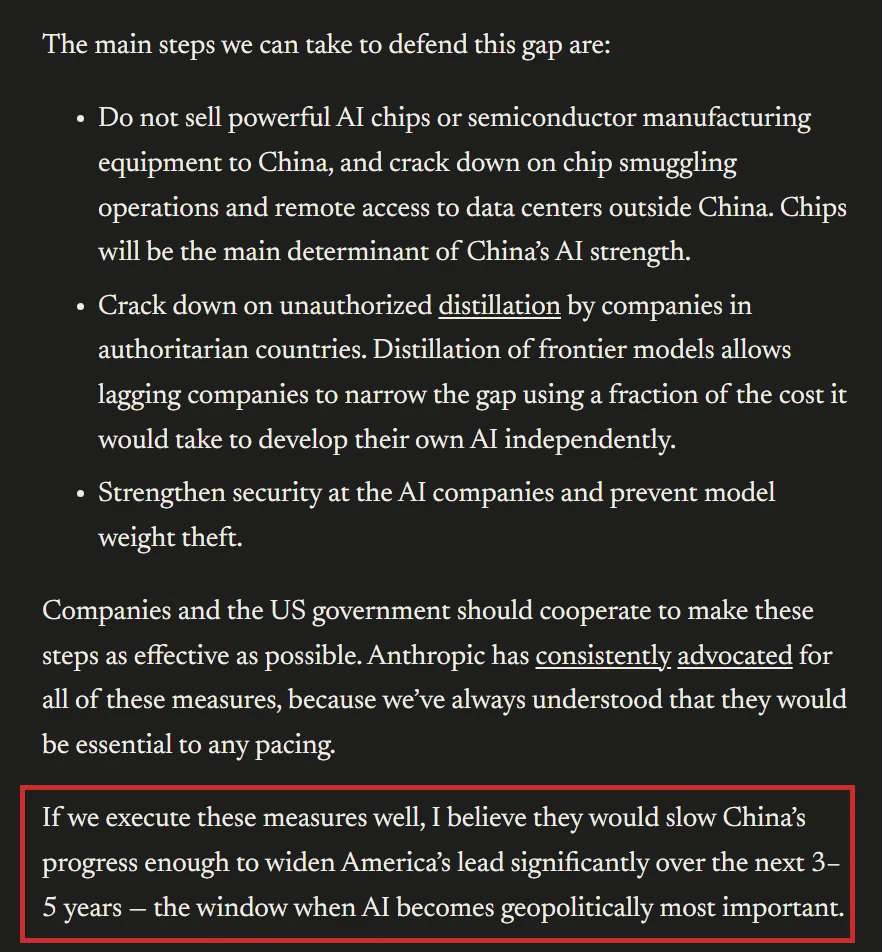
Source: Dario Amodei — We Must Pace the Frontier, September 2026; red box added by HSL
- China's state-backed Global Times called the essay a Cold War playbook to protect US tech dominance (Rest of World)
Top Models Get Stockpiled and Used In-House
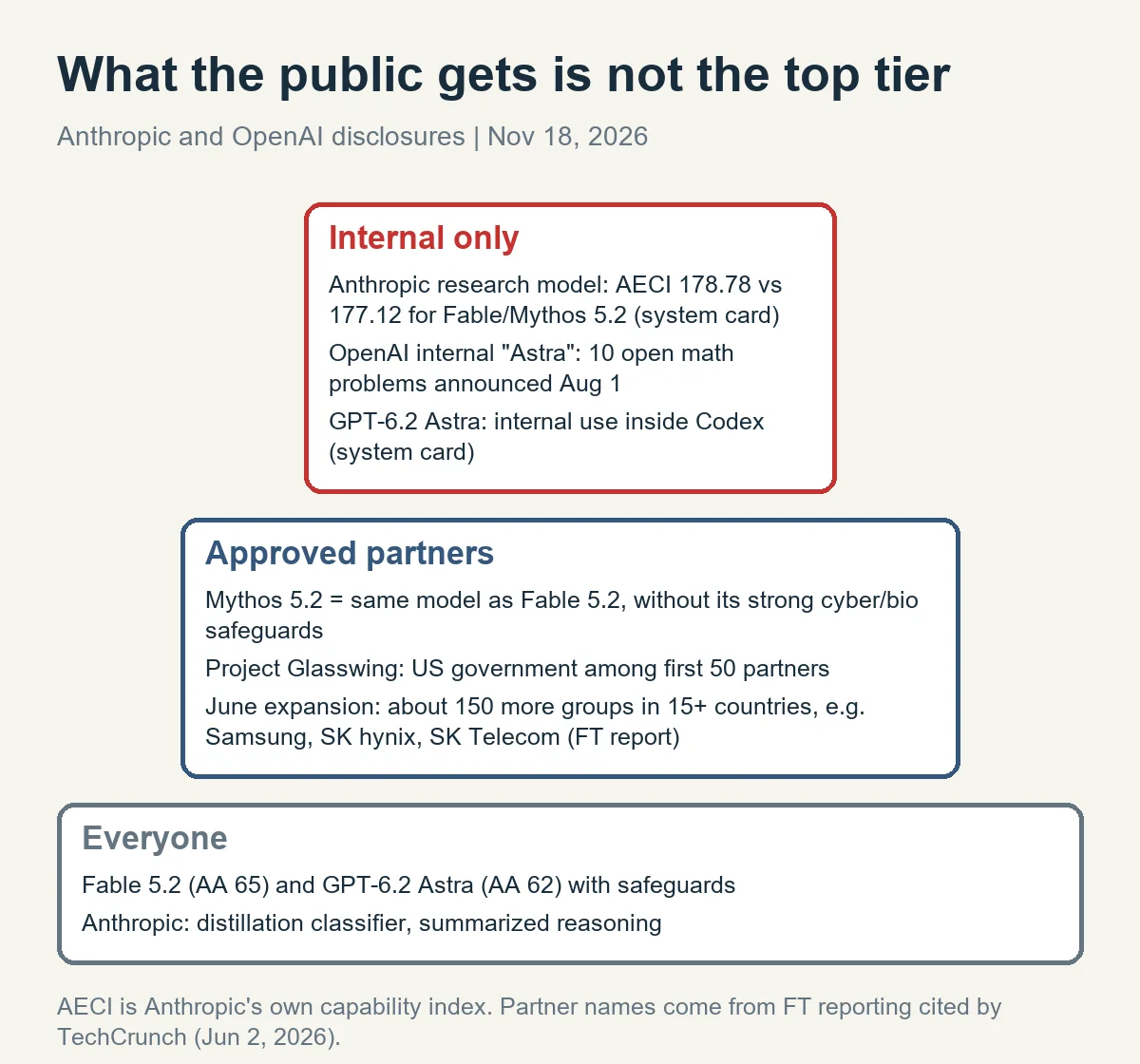
- Like Astra, which made headlines by solving hard math problems, US labs keep stacking top models and improving them in-house, widening the gap with other countries (author's view)
- To be precise, the math results came from an unreleased internal version of Astra that OpenAI announced on August 1 (TNW)
- It produced new results on 10 math and theoretical computer science problems open for over a decade, with machine-checkable Lean 4 proofs
- At the time, OpenAI did not say when that model would ship
- The GPT-6.2 Astra system card says OpenAI has been expanding the model's internal use inside Codex (system card)
- The same card calls GPT-6.2 Astra its first externally released model to meet the High threshold for AI self-improvement
- Dario Amodei also wrote that since this summer, AI building the next generation of AI has started across the industry, Anthropic included
- Anthropic says its first formalization of Fermat's Last Theorem was done by an unreleased research version of Claude (Anthropic)
- The outside evaluator METR wrote that Anthropic is holding recent models slightly longer before public release4 (METR)
Made by HSL — Anthropic system card, OpenAI system card, TechCrunch
The Biggest Clue Is the Number 5.2
- The key evidence is Fable 5.2. It is the world's top model and far ahead of 5.1, so it could have been called 5.5. It is 5.2 because a 5.5 already exists inside (author's view)
- Fable 5.2 leads AA at 65, 16 points above Fable 5.1 (49) at the same max setting (earlier Fable post)
- Yet Opus, Sonnet and Haiku are already at 5.5, while Fable, the top line, sits at 5.2
- The system card lists an unreleased internal research model scoring above Mythos 5.2: 178.78 vs 177.12 on Anthropic's own index5
Not Everyone Gets Mythos
- Anthropic keeps its strongest model, Mythos, from the public, and the US government and key companies are probably using it. That points to the US holding AI dominance even more firmly (author's view)
- Anthropic says Fable and Mythos are the same underlying model (Anthropic)
- Fable has strong cyber and biology safeguards, and only approved applicants get Mythos
- Since Mythos Preview in April, it has gone only to Project Glasswing partners, and the US government was among the first 50 (TechCrunch)
- In June it expanded to about 150 more organizations in 15+ countries friendly to the US
- According to the FT, Samsung, SK hynix, SK Telecom and NATO are among them6
Two Paths Left for Every Country
- To have a say, a country must either keep building its own AI like the US, or pay to use top models that are not public through friendly ties with the US (author's view)
- Even now, most countries' own AI struggles to match the AI the US has released publicly (author's view)
- On the same AA v5 test, the top US models score in the 60s and China's best scores 46 (AA leaderboard)
Made by HSL — AA leaderboard, checked November 18, 2026
- Korea's government admits the gap. In August, its science ministry said the top team, Motif, scored 47 against 63 for Claude Opus and others7 (Money Today)
- Hitting the program's goal of 95% of frontier models would have needed 57 or more
- The vice minister said major countries are now treating AI models as national security assets
- So instead of splitting GPUs across teams, the ministry is considering concentrating them on one frontier-class model
- The second path already has examples. If the reports are right, Korean firms such as Samsung and SK already use Mythos through Glasswing
So What's Next?
- First, watch the next Fable number. If this picture is right, the next one should be 5.5 or higher, not 5.3
- Second, watch the AA gap. See whether the 19-point lead over China's best holds after Kimi K3.1 Pro's weights and the next DeepSeek arrive
- Third, Korea. The program's third-round evaluation and the ministry's frontier-model plan are still to come
- Anthropic is set to list on Nasdaq on November 19. If this picture is right, it will not release its top models all at once after the IPO either
- Dario Amodei sees the next 3–5 years as the period when the lead matters most
- This is my personal view as a working AI developer, and pushback and criticism are welcome (author's view)
Q&A (Field Notes)
- Q. Is Mythos a hidden model stronger than Fable?
- No. Anthropic says they are the same model; only the safeguards and who can use it differ
- The truly unreleased model is the internal research model whose score appears in the system card
- Q. Does a 19-point gap mean Chinese models got worse?
- No. Going from 3 to 12 points was mostly the test switching to private questions; 12 to 19 came from US models improving
- Q. Is distillation illegal?
- The technique itself is common. The problem is mass extraction of another lab's model through fake accounts in breach of its terms
- Many observers say its legal status is still unsettled (TNW)
Footnotes
-
※ Part of the jump from 3 to 12 points comes from the test overhaul (60% private questions) (Dealroom). Other yardsticks show a smaller gap: Stanford AI Index 2.7% (TNW), Epoch AI about 7 months on average (Epoch AI) ↩
-
※ These are Anthropic's figures; the named labs' side has not been confirmed ↩
-
※ Anthropic's stated reason is safety ↩
-
※ METR's wording is "slightly longer"; the exact period is not confirmed ↩
-
※ Whether this internal model is 5.5 is not a confirmed fact ↩
-
※ Specific uses have not been disclosed ↩
-
※ That was on an older index version, so it is hard to compare directly with v5 scores ↩