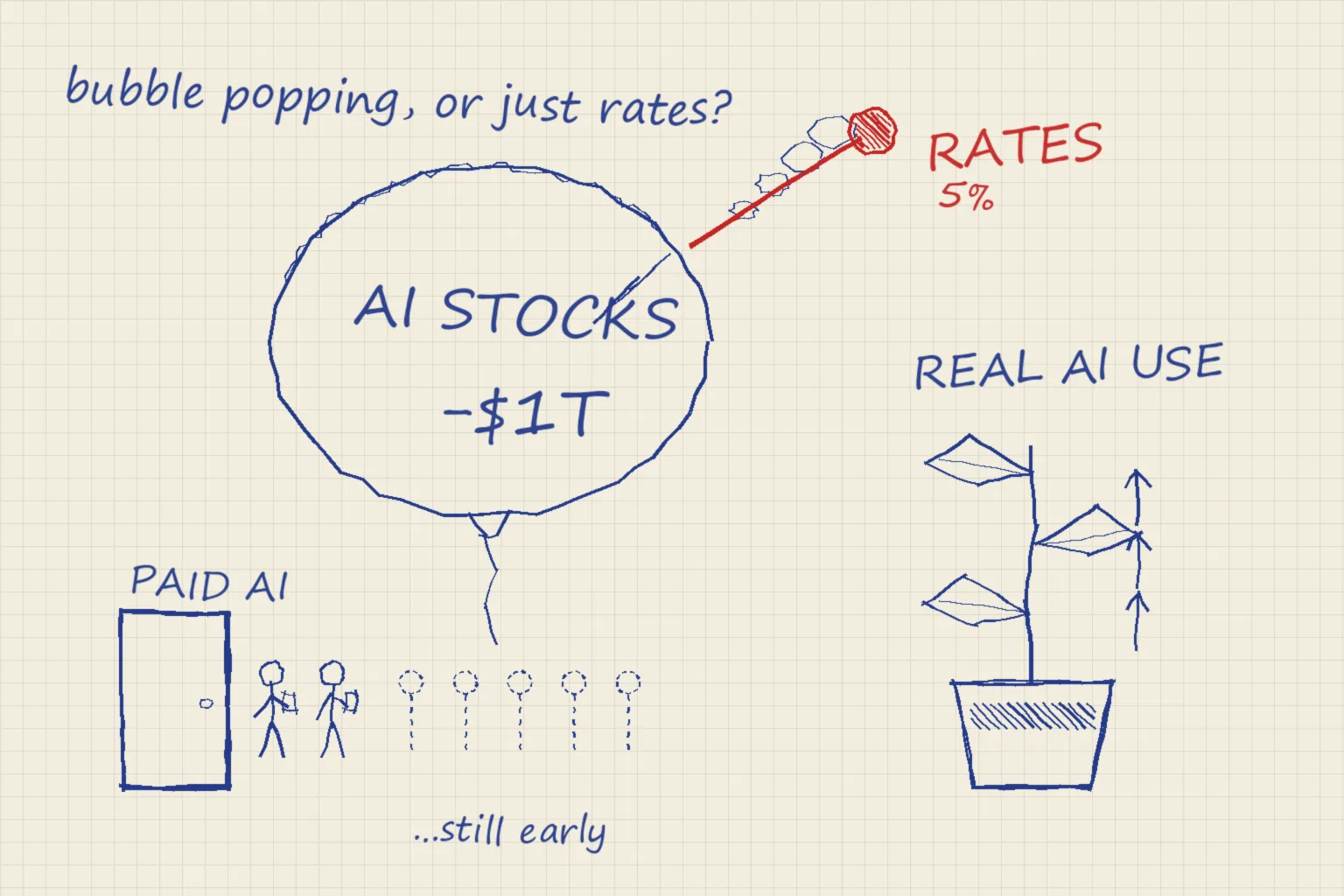
3-Line TL;DR
- Twenty major AI and chip stocks lost $1 trillion in market value in a single week
- AI bubble talk is nothing new, but this time it arrived together with rate hikes and pricier money
- AI use keeps growing and paid adoption is still early, but that does not guarantee today's stock prices
$1 Trillion Gone, and a 5% Rate Tag on the Bill
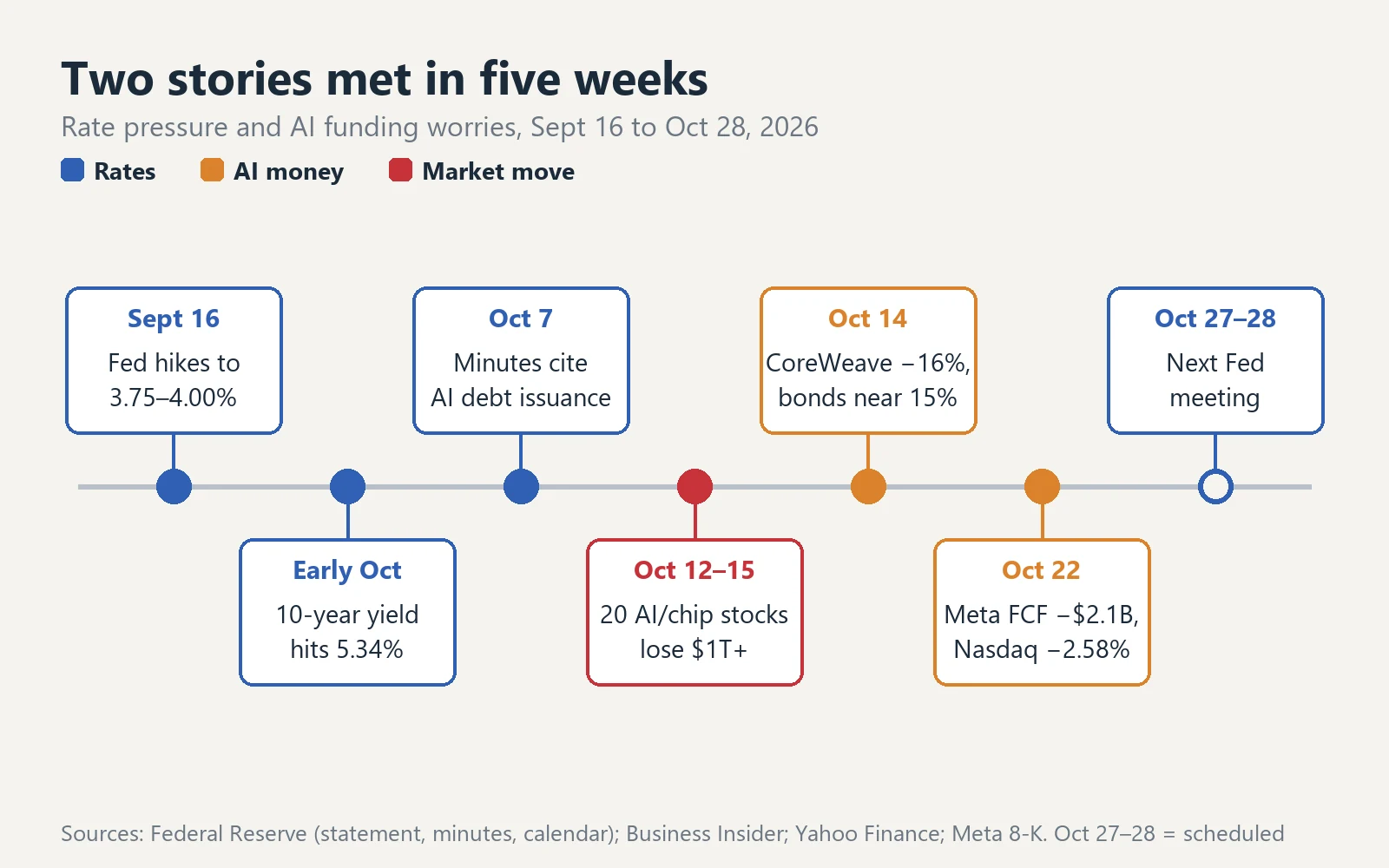
Made by HSL — Fed statement, minutes and calendar, Business Insider, Yahoo Finance and Meta's 8-K
- AI bubble talk has always been around; in my view it hit this hard because rate hikes came at the same time
- In the week of October 12, 20 major AI and chip stocks lost more than $1 trillion in market value (Business Insider, citing CNBC)
- The "$1.6 trillion" headline is a different basket: the 30 Philadelphia Semiconductor Index companies (Reuters)
- On October 15 alone, SK Hynix fell 11% and Samsung Electronics 9% (Business Insider, Hankyung)
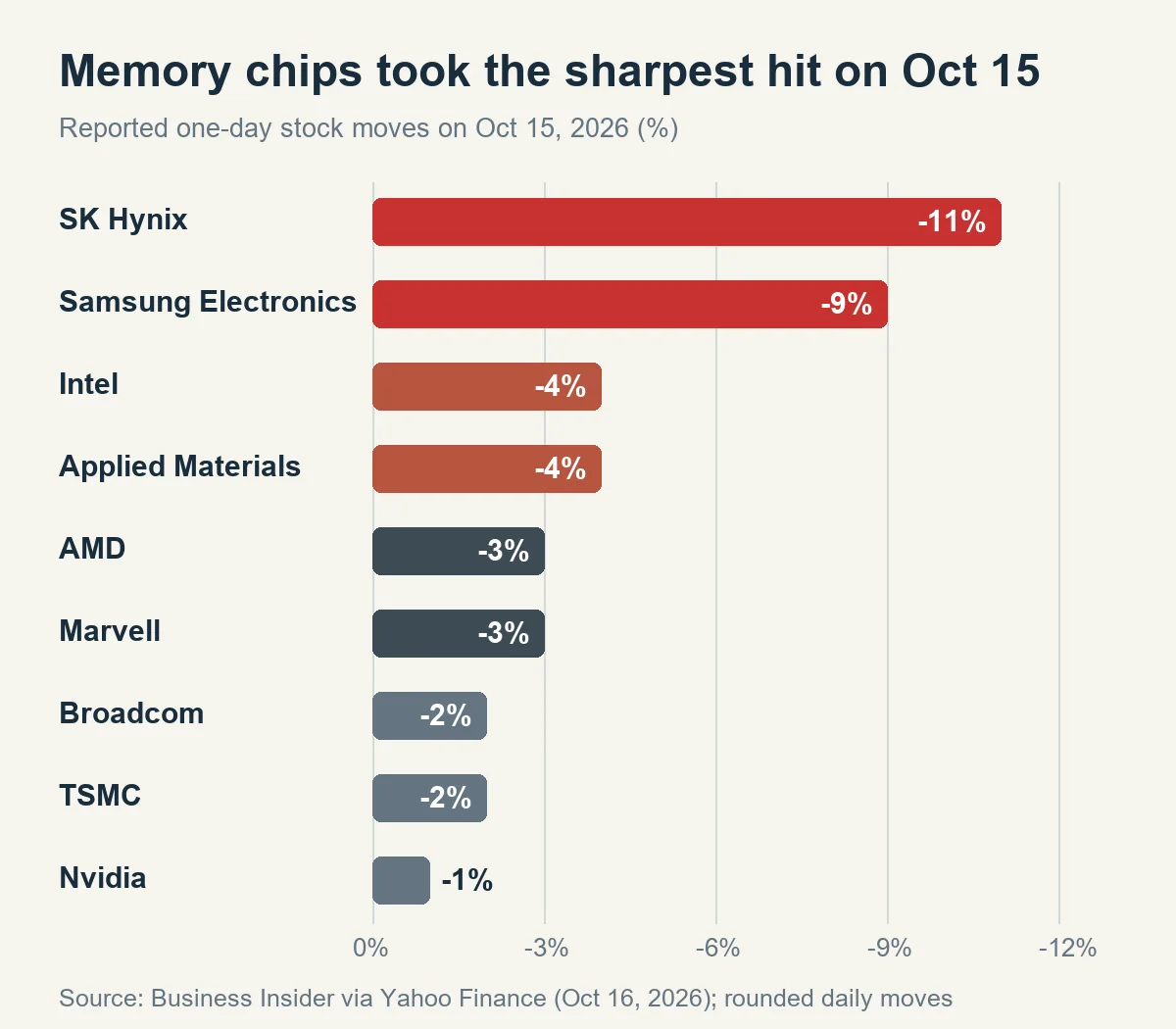
Made by HSL — data from Business Insider via Yahoo Finance (Oct 16, 2026)
- The backdrop was the Fed's September 16 hike to 3.75–4.00%, a 12–0 vote (Federal Reserve statement)
- September CPI came in at 3.7% against a 3.6% forecast, and producer prices jumped 6.3% (Business Insider)
- Odds of another hike by year-end rose to 92%, and the 10-year Treasury yield touched 5.34% in early October
- The Fed's September minutes record market commentary pointing to AI infrastructure debt issuance as one driver of higher yields (FOMC minutes)
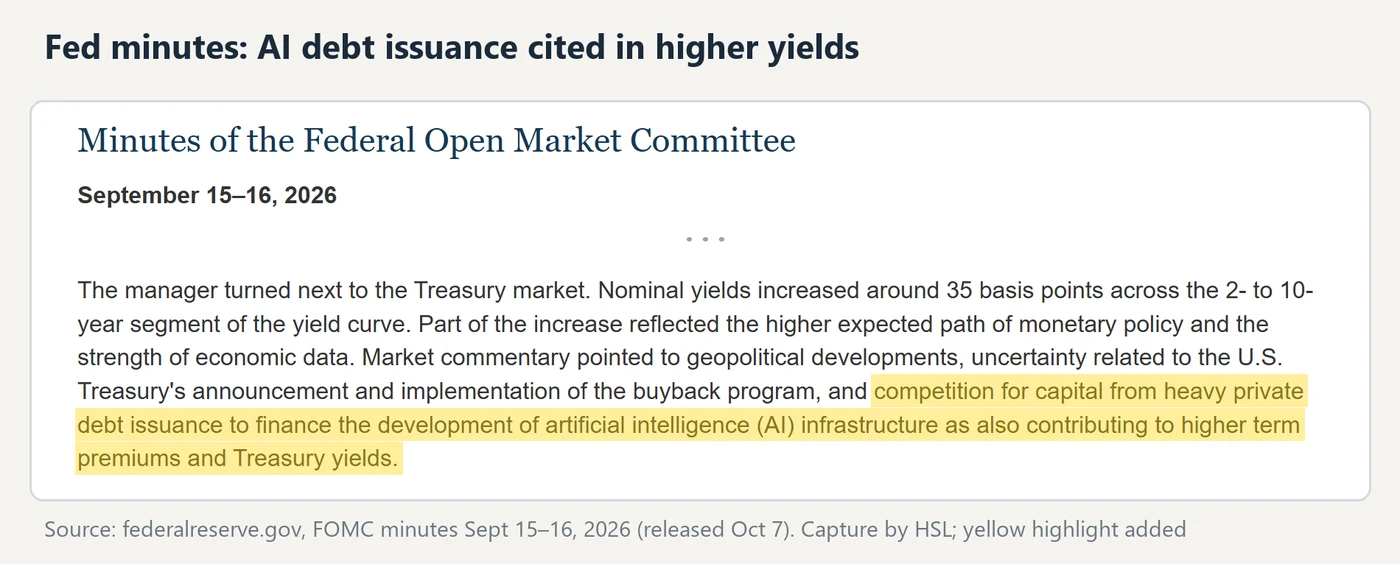
Captured by HSL — Fed September FOMC minutes, yellow highlight added by HSL
- Companies building GPU data centers with borrowed money got hit first
- Yields on CoreWeave's 2032 bonds went from 9.625% at issue to nearly 15% (Yahoo Finance)
- CoreWeave's stock fell more than 16% on October 14 alone
- On October 22, Meta reported Q3 free cash flow (cash left after spending) of −$2.12 billion (Meta filing)
- The Nasdaq fell 2.58% and the S&P 500 1.19% that day (Yahoo Finance)
| Indicator | Figure | Why it pressured AI stocks |
|---|---|---|
| Fed funds rate | 3.75–4.00% (hiked Sept 16) | Raised the discount rate on future tech earnings |
| Sept CPI · PPI | +3.7% · +6.3% | Kept 10-year yields above 5% |
| CoreWeave 2032 bond yield | 9.625% → about 15% | Debt-funded data centers saw capital costs jump |
| Big Tech 4 capex | $725B–$745B in 2026 (MLQ) | Meta, Alphabet and Amazon free cash flow turned negative |
What Our Three AI Portfolios Did on October 22
Captured by HSL — AI Stock Duel project page (updated Oct 23, 07:31 KST, Oct 22 close)
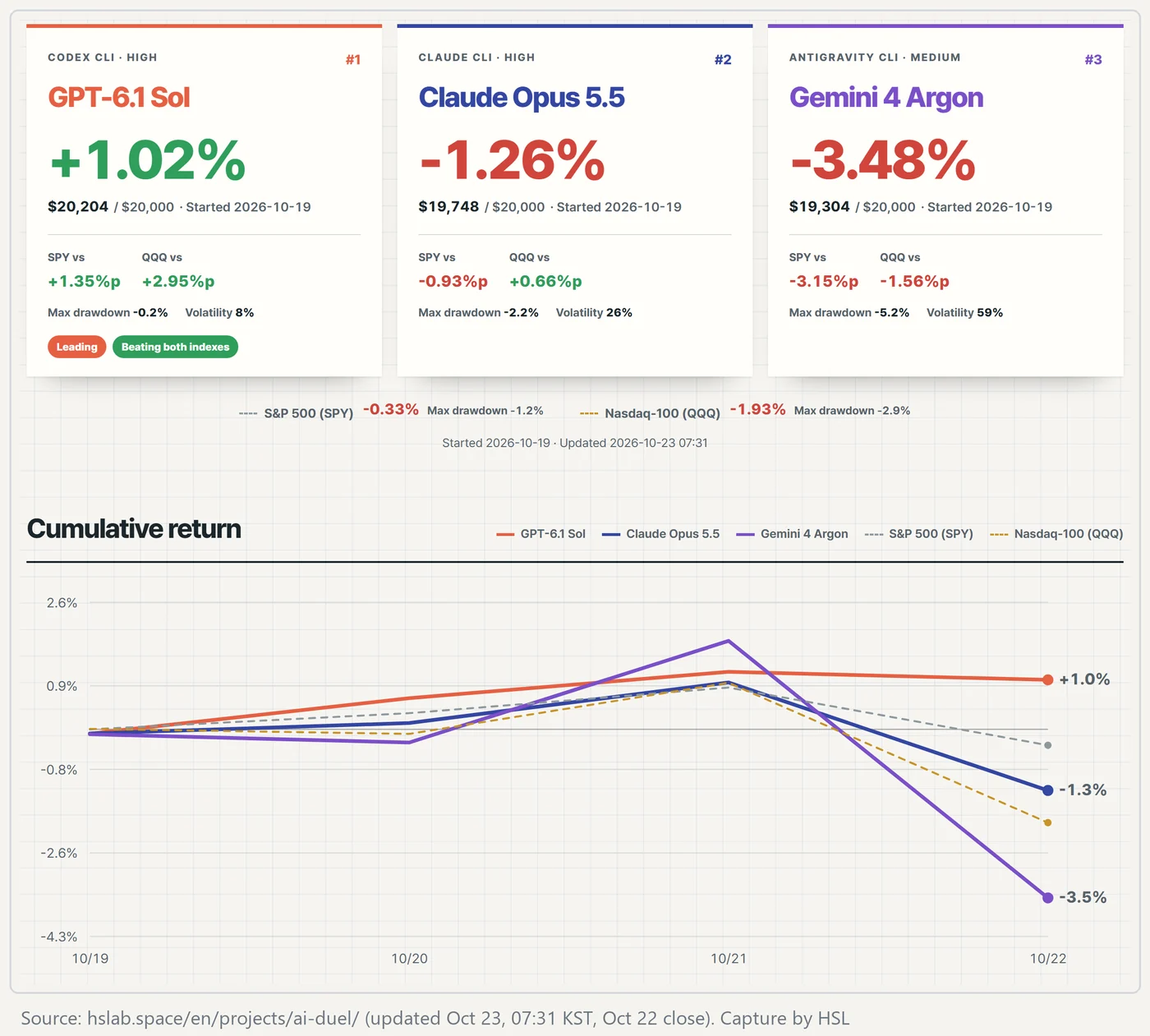
- The same shock showed up in our AI Stock Duel project (project story)
- Three AIs each started with $20,000 in paper money on October 19
- On October 22, when
QQQfell 2.9%, results split by how much AI-chip and leverage exposure each held - Gemini 4 Argon held 30% in 2x Nasdaq
QLDplus 20% each inNVDAandTSM, and lost 5.2% in a day - Claude Opus 5.5 built around 42%
QQQwith energy and healthcare mixed in, and lost 2.2% - GPT-6.1 Sol held 46% equal-weight
RSPand 20% financialsXLF, and lost just 0.2% - Buying chip dips with leverage looks brave right until the rate bill arrives
- With only three trading days of history, this says nothing about which AI is the better investor
Everyone Uses AI, Few Pay for It Yet
Made by HSL — data from Pew Research Center, a16z / YipitData and U.S. Census BTOS. Different populations, so do not compare grids directly
- Anyone who actually uses AI can tell people will keep using it (my view)
- Yet few people pay out of pocket, so the market including businesses still looks huge to me (my view)
- ChatGPT passed 1 billion weekly users (OpenAI), and the Gemini app passed 1 billion monthly users (Google)
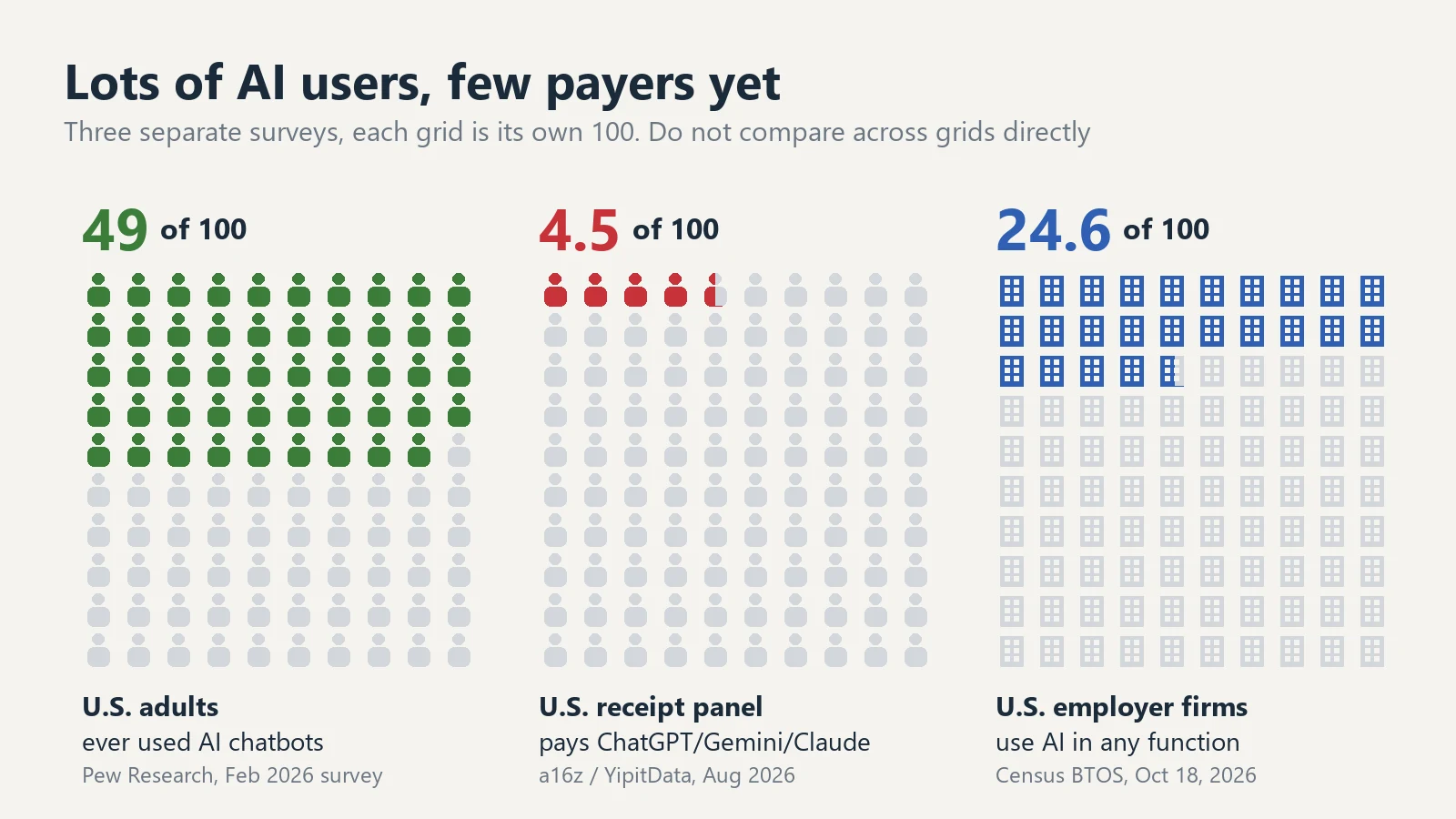
- 49% of U.S. adults have used an AI chatbot, and 24% use one daily (Pew, February 2026 survey)
- But only 4.5% of a U.S. consumer receipt panel paid for a personal subscription (a16z / YipitData, August 2026)
- That doubled from 2.1% a year earlier, but it is still a single digit
- 24.6% of U.S. employer businesses use AI (Census BTOS, October 18)
- That rose from 17.3% last November and 19.8% in May, and 28.6% plan to use AI within six months
- These business figures follow a new series after a November 2025 question change, so they do not join older numbers
- Menlo's "55% pay" asked only AI users and counts accounts paid by family or employers, so read it separately (Menlo Ventures)
Growing Usage Does Not Make Today's Prices Safe
- Growing use shows AI is not an empty shell, not that today's stock prices are cheap
- Anthropic's Q3 revenue reached $16.8 billion, up about 45% from Q2 (Reuters, Business Insider)
- The quarter before had grown about 145%, so growth slowed sharply
- OpenAI's September annualized revenue (one month × 12) was about $50 billion, below an earlier ~$70 billion figure (Reuters)
- Cheaper tokens drive more usage (our cost comparison), but can cut revenue per unit (Reuters Breakingviews)
- Consumer subscriptions showed slower Claude sign-ups and rising churn in July–August (a16z)
- In the end, rates, data-center debt, Chinese memory rivals and monetization doubts all piled up at once (Investing.com, Business Insider)
- Believing in AI's future and respecting what rates do to expensive stocks are two separate things (not investment advice)
Community Reactions
- r/ClaudeCode user desktop1020 says they paid $20 each for ChatGPT and Claude in September but now want just one subscription (Reddit)
- r/singularity user Ankleson says their coding-agent workflow progressed from splitting small tasks to delegating a large feature (Reddit)
- r/stocks user NoGap1566 interprets semiconductor losses as financing-cost and valuation concerns rather than a demand collapse (no measurements) (Reddit)
- r/wallstreetbets user Sp00kyC4py worries hyperscaler debt and off-balance-sheet liabilities could spread to major technology-stock valuations (no measurements) (Reddit)
Q&A (Field Notes)
- Q. Some headlines say $1 trillion and others $1.6 trillion. Which is right?
- Both: $1 trillion is 20 major stocks over one week, $1.6 trillion is 30 Philadelphia Semiconductor Index companies over under two weeks (Business Insider, Reuters)
- Q. Why do paid-subscription figures range from 4.5% to 55%?
- Q. TSMC's results were strong, so why did it fall too?
- Q3 revenue rose 50.9% (Dealsite), but higher rates make investors stricter about customer debt and when Big Tech capex pays back
- Q. When is the next U.S. rate decision?
- The FOMC meets October 27–28, and the year's last meeting is December 8–9 (Federal Reserve calendar)